Everyone wants to know where the herds are today.
Searches for a wildebeest migration tracker in Kenya typically come from one of three types of travelers: someone choosing between safari months, someone already booked trying to calibrate expectations, or someone considering a last-minute trip. Live migration updates are genuinely useful for all three groups, but they can also mislead if you treat them as more precise than they are.
This guide explains what migration trackers are, what they can reliably tell you, where they fall short, and how to translate broad herd location data into practical decisions.
What Is a Migration Tracker?
A migration tracker is any resource that reports recent herd movement across the Serengeti-Mara ecosystem. The term covers a range of sources with different levels of reliability and frequency:
- Lodge and camp updates posted on social media
- Operator newsletters and live blog sections
- Conservation organization monitoring reports
- Guide radio network summaries shared online
- Guest sighting reports aggregated by travel platforms
Common tracker-style reports look like this: “herds seen near the Sand River,” “crossings reported at Purungat Bridge,” “large columns moving toward the northern Serengeti,” or “animals gathering near the Mara Triangle.”
The phrase “wildebeest migration live Kenya” sounds exact, but the migration is not a package on a tracking app. Herds spread across enormous areas. Different columns move at different speeds. Multiple groups can be in completely different sections of the ecosystem at the same time.
What Trackers Are Genuinely Useful For
A reliable migration tracker resource serves its purpose well when you use it for broad orientation rather than precise prediction.
It can credibly answer:
- Whether the herds are generally in Tanzania or Kenya at this point in the season
- Whether Mara River crossings have started this year
- Which broad zones are seeing active herd movement this week
- Whether the migration is running early or late relative to the typical calendar
- Whether recent rainfall has shifted the herds’ direction or pace
This helps travelers comparing July vs August, or weighing whether to push a trip back a week. It also helps guests who are already booked understand what the season is doing before they arrive.
What Trackers Cannot Tell You
The limitations matter as much as the capabilities.
Migration trackers cannot reliably tell you:
- Whether a crossing will happen on your specific safari dates
- Which exact river point will be active on a given morning
- What time of day the next crossing will begin
- Whether all the herds are in one area or spread across dozens of kilometres
- Whether your camp has road access to the reported location
- That yesterday’s active crossing point will be the same tomorrow
The current migration location in Kenya may be accurate in a general sense without being precise enough to drive daily safari decisions. The Mara is large. Road conditions, reserve boundaries, and conservancy access rules all affect whether a reported sighting translates into a viewable crossing from your camp.
How Experienced Guides Actually Track the Herds
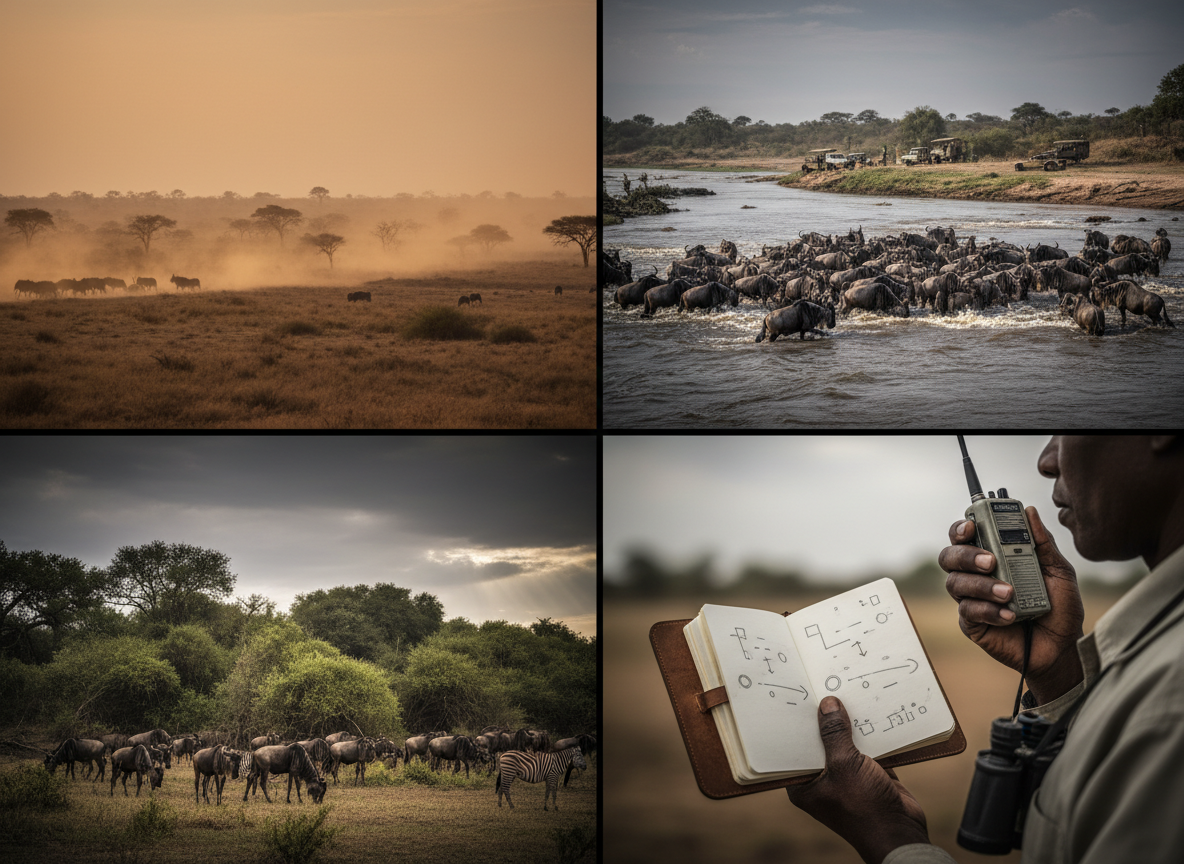
Skilled guides working the Mara during migration season do not rely primarily on online posts or social media updates. They combine multiple information streams:
- Morning field reports from other guides in different sections of the reserve
- Radio network updates throughout the day
- Direct communication between camps sharing sighting intelligence
- Fresh tracks, dust line direction, and predator positioning read in the field
- Weather and river level monitoring
- Reading herd behavior at the bank, which often signals whether a crossing is hours or days away
The gap between “herds near the river” as a tracker report and the specific, actionable intelligence that decides where to position a vehicle on Tuesday morning is the gap that local guide knowledge fills. If a tracker says herds are near the river, an experienced guide asks which bank, which crossing zone, what the water level is doing, and whether the lead animals are exhibiting pre-crossing behavior.
That distinction is the difference between information and usable safari planning.
Where the Wildebeest Are: A Seasonal Map
During a normal migration cycle, the broad herd location by period follows this pattern:
| Period | General Herd Location |
|---|---|
| January to March | Southern Serengeti, Ndutu calving areas, Tanzania |
| April to May | Central and western Serengeti movement northward |
| June | Western corridor, Grumeti River crossings, northern Serengeti build-up |
| July to October | Northern Serengeti and Masai Mara, Kenya |
| November to December | Southward return movement after short rains |
If you ask where the wildebeest are in August, the honest answer in most years is: some in the northern Serengeti, some in Kenya, with the Kenya herds concentrated around the Mara River crossing zones. The migration is not one herd in one location. It is many columns at different stages of the same journey.
How to Use Tracker Data Before Booking
Use tracker information for broad timing decisions, not for fine-tuning itineraries at a distance.
Before booking, useful tracker-informed questions to ask:
- Are the herds running early or late this season compared to the typical calendar?
- Have crossings started in Kenya, or are herds still building up in the northern Serengeti?
- What does the current situation suggest about July vs August vs September odds?
- What are local operators saying about access to active crossing zones?
Avoid changing plans based on a single social media post. One crossing reported at a specific point does not mean that point will be active when you arrive three weeks later. Book enough nights (three minimum, four to five for better odds) to allow for natural variation.
The most productive pre-trip use of tracker data is to inform a conversation with a local operator who has their own ground intelligence. Bring the data you have seen; ask them to contextualize it.
How to Use Tracker Data During Your Safari
Once you are in the Mara, the most important thing you can do with migration tracker data is give it to your guide and ask their interpretation. Your guide will know:
- Whether the reported crossing point is accessible from your camp’s section
- Whether the herd movement pattern suggests the crossing is building or dissolving
- Whether the report is hours old and conditions have since changed
The trap to avoid is treating every social media sighting as an instruction. During a busy August week, 20 different posts may report crossings at different points across the Mara simultaneously. Some will be accurate; some will be delayed; some will describe a single small group rather than a full crossing event. Your guide’s radio network provides real-time ground intelligence that no online tracker can match.
The best pattern during a safari: check public updates for context awareness, then trust your guide completely for daily field decisions.
Should You Book Last Minute Based on Tracker Data?
Sometimes, if conditions are right. A strong live update during peak season, combined with available camp space, can make a last-minute trip worthwhile for flexible travelers already in Kenya.
The constraints are practical:
- August is the hardest month for last-minute bookings because camps fill 9 to 12 months ahead
- The herds may be active but the camps and vehicles you want may not be available
- Last-minute bookings frequently carry premium pricing
If a live tracker is prompting you to consider a last-minute migration safari, the right approach is to contact a local operator directly, ask what camp space is available, and prioritize access to the active zones over famous camp names. A less well-known camp 15 minutes from the active crossing zone is worth more than a famous lodge that is 45 minutes away.
Stay at least three nights. Accept that availability narrows on short notice and costs more.
How Often to Check Before You Travel
Months before your trip: weekly checks are sufficient. The migration does not change dramatically week to week at this range.
Two to four weeks before arrival: more frequent tracking becomes useful. This is when your operator should be looking at current season conditions to adjust your daily drive strategy if needed.
During your safari: check minimally and only to share with your guide. One daily check of what other vehicles are reporting is reasonable. Following every update across multiple platforms creates noise without adding useful signal.
Explorer Notes: Interpreting What You Read
A few patterns worth knowing when reading migration tracker reports:
“Herds near the river” means different things in different months. In July, it may mean the leading columns are arriving. In September, it may mean the large herds have been there for weeks and crossing activity is well established. Context on the seasonal calendar matters.
Crossing reports often describe specific points. Sand River, Purungat Bridge, and the Mara Triangle are different locations within a large reserve. Access to each depends on your camp’s position. “A crossing happened” is less useful than “a crossing happened at X, and we can drive there in 20 minutes.”
Lodge social media is often a day or two behind. Photos take time to post. A report of a crossing on Monday morning may not appear online until Tuesday. Treat tracker data as a lagging indicator, not a real-time feed.
Low crossing activity does not mean the herds are absent. Herds can spend days in the Mara grazing away from the river before returning to attempt another crossing. Tracker silence does not mean the wildlife is elsewhere.
Conclusion
A wildebeest migration tracker is a useful planning tool and a poor substitute for local field intelligence. Used well, it helps you choose the right month, set realistic expectations before arrival, and have informed conversations with your operator. Used poorly, it creates anxiety about conditions that change daily and generates pressure to make decisions based on incomplete information.
Know where the herds broadly are. Then let a guide with a radio and years in the field tell you where to be on the morning that matters.
Related Reading
- Wildebeest migration safari Kenya: the complete planning guide
- The wildebeest migration route: understanding the full circuit
- What to expect on a migration safari in Kenya
- Wildebeest migration facts: 20 things that change how you see the herd
- For current season migration updates from guides on the ground, Trunktrails Safaris provides pre-trip briefings based on live field conditions rather than published timetables.
Turn this reading into a real itinerary with help from a Kenya-based safari team.
Start Planning Your SafariFurther reading
Related Kenya safari guides
- How Kenya Safari Operators Are Adapting to Fuel Costs
- Kenya Safari Tipping Guide 2026: How Much to Tip
- Kenya Self-Drive Safari: Routes, Permits and What to Know
- Safari Travel Insurance Kenya: What Coverage You Actually Need
- Seasons in Lewa Conservancy: A Month-by-Month Guide
- What to Wear in Nairobi National Park: Day Safari Guide
- Night Game Drive Kenya: Where to Go and What to See